I’m Still Here. This Time, I’m on My Own Side.
I spent years becoming everything everyone else needed. I survived because I finally became the person I needed.
I’m still here.
I don’t mean that I’m still working, still cooking or still finding a way to keep the bills paid—although all of that is true.
I mean I am finally present in my own life.
After nearly three decades in hospitality, national television, twenty-three corporate cafés, hundreds of meal clients, one restaurant, several reinventions, a broken body, depression, alcohol, weight gained and lost, relationships that didn’t make the final cut and more pivots than I could possibly count, I’m still here.
And for the first time in a long time, I’m not merely surviving.
I’m better than ever.
I didn’t discover food in culinary school or inside a professional kitchen. I was raised around people who understood that food could be both an art and an act of love.
There was perfect Greek chicken, potatoes and pastitsio at my yiayia’s lakefront condo; creamy chicken risotto and chicken cacciatore from my stepmom; and my mom’s chicken Kiev and rice pilaf at our house. When I played softball, she made baked pasta for our team’s carbofests, along with her killer Caesar dressing and homemade croutons. The team always commented on how great everything was. She made sure the food she served us was delicious.
My first real culinary gig came when I was sixteen and became my aunt Diane’s sous chef. She wasn’t my biological aunt—that title belongs to Aunt Becky, the fashion designer—but Diane was family. She was a flight attendant who also performed food demonstrations for a specialty-food company, and she had a passion for making food perfectly balanced.
I can still picture us at Sam’s Wine & Spirits making vinaigrette.
I didn’t know I was beginning a career. I was just a teenager helping someone who cared about getting food exactly right.
That standard stayed with me.
Cooking continued to find me even while I was partying my way around anything resembling a sensible life plan. After failing most of my classes at Western Michigan University, I spent a summer working in mosquito abatement and at Fritz and Zoe’s catering company.
It was supposed to be punishment. It also allowed me to get back to Kalamazoo and my friends, so as punishments go, I found the loophole.
I was also moonlighting at GapKids during that era. I couldn’t fold for shit, so they stationed me at the entrance, handed me a yo-yo and had me greet people.
Hospitality? Absolutely.
Retail merchandising? Apparently not.
Back in Kalamazoo, I began working at Asiago’s Bakery and Deli. I worked my way through the ranks and eventually became a manager before leaving school and returning to Chicago in 2005.
One of our delivery boys was a fifteen-year-old high school student named Eric. We stayed connected through social media, and years later, when I needed a sous chef in Chicago, he moved from Kalamazoo to work beside me. He became my adoptive brother. Today, he is an executive chef back in Kalamazoo, and we remain part of each other’s lives.
People often describe a career as a sequence of titles. Mine is really a collection of people: teachers, chefs, clients, teammates and friends who saw something in me, challenged me and gave me another place to grow.
When I returned to Chicago, I worked at Think, a fine-dining restaurant featured on PBS’s Check, Please! At the end of 2006, I was recruited by a Northbrook catering company called Hel’s Kitchen—short for Helen, although the irony is not lost on me.
Six months later, I joined Food For Thought.
I started as sous chef at the Sidley Austin LLP account in 2007. From there, I became chef at Adler Planetarium and then executive chef and general manager at BP. In 2012, I added regional-chef responsibilities. By 2015, I was division chef overseeing all twenty-three of Food For Thought’s business-dining locations.
Business dining was my primary world, but whenever the catering division needed all hands on deck, I was there too.
For almost a decade, I learned how to run kitchens, lead teams, open accounts, solve problems and keep service moving regardless of what was happening behind the scenes. I became very good at keeping shit moving.
I was not always as good at recognizing when I was the thing falling apart.
I was hired by two people who remain important to me today: Rosie, a chef herself and the recruiter who brought me in, and her husband, John Reed, the corporate chef. Because Rosie understood the work firsthand, she knew exactly what the job required—and what she saw in me. John is a Certified Master Chef who taught me far more than cooking. He taught me how to lead and helped me grow up during my twenties.
Years later, John and Rosie came to eat at my restaurant.
That meant more to me than they probably knew.
During my second year at Food For Thought, a customer watched me work and said I should audition for Hell’s Kitchen. Auditions happened to be taking place nearby at the Art Institute of Chicago, so I asked my chef if I could go.
I figured, why not?
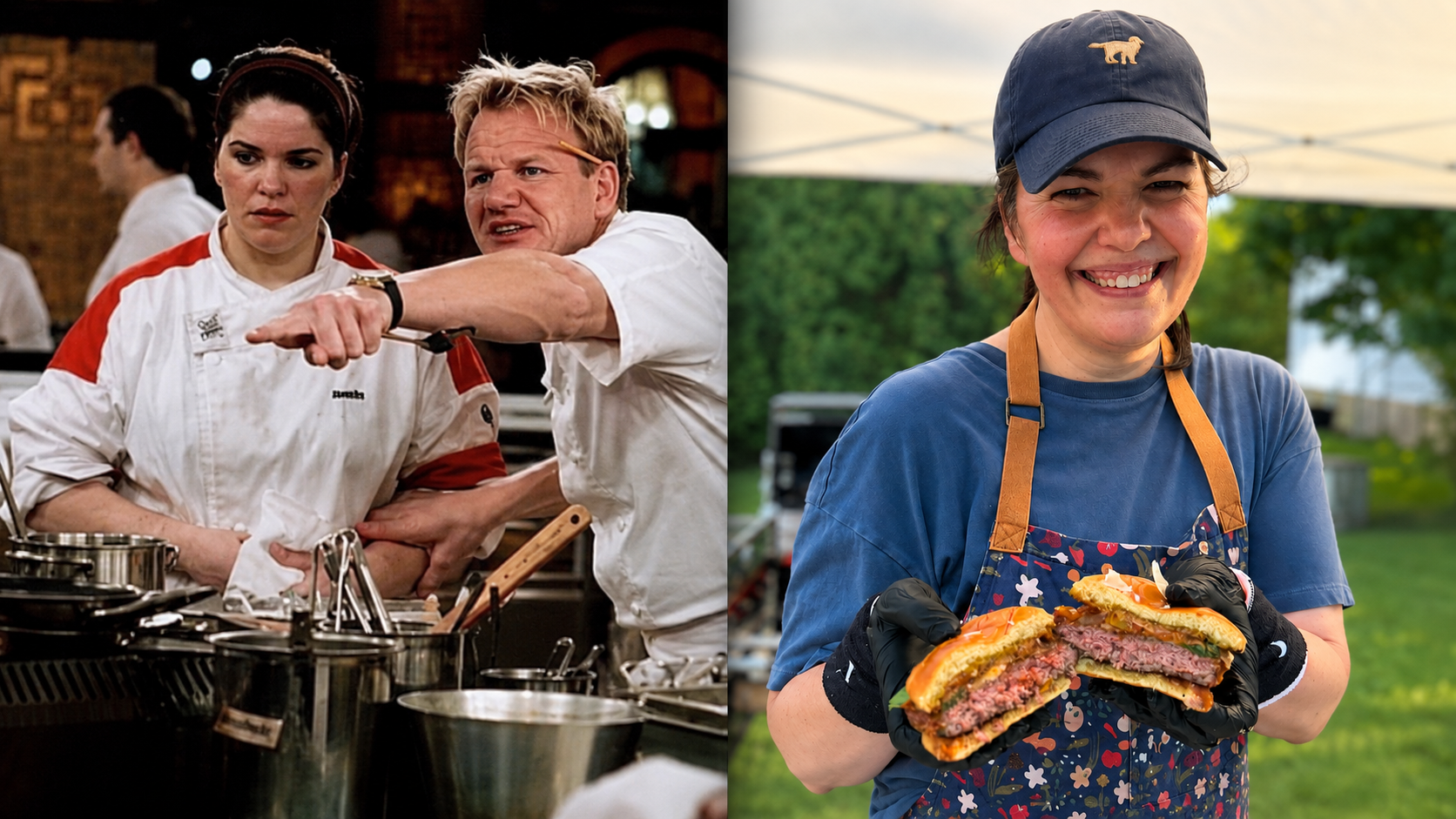
That audition became a callback. The callback became a year-long process. Eventually, I appeared on season seven of Hell’s Kitchen.
Seeing myself on television was one of the most bizarre experiences of my life. People say the camera adds ten pounds, but there were seventy-something cameras, so do the fucking math.
The weight was only part of it. Learning what you actually look like while running through every possible emotion is wild. Most people never have to watch their own face cycle through stress, confidence, fear, embarrassment, frustration, exhaustion and disappointment—on national television, from every possible angle.
I did.
The experience should have given me the greatest confidence boost of my life. Instead, I watched myself fail to meet my own expectations from more than seventy different angles. It gut-punched my confidence.
So I did what I had learned to do whenever something hurt.
I went to work.
For years, work became my armor. Being needed felt safer than being known. Fixing everyone else’s problems meant I didn’t have to sit still with the things I couldn’t fix.
If I could run the kitchen, rescue the service, support the team, feed the clients and carry the weight, then I had value. I became indispensable because usefulness felt like the safest version of love.
It was also an excellent way to remain emotionally unavailable—even to myself.
When I left Food For Thought in 2016, I consulted for restaurants throughout the North Shore and took catering projects. I also started CubbieCakes, named after my family’s golden retriever, Cubbie.
Before changing my college studies to food science, hospitality and business, I had been an art major with an emphasis in ceramics. Clay and fondant turned out to require surprisingly similar hands. I already knew how to sculpt; now I could make the sculpture taste good.
In 2018, a personal health change led me to begin preparing Paleo meals for other people. I taught myself how to build and operate the business. There were no investors or massive marketing teams. There was me, my food, a website I learned to build and a growing list of people who trusted me to feed them.
Four clients became dozens. Dozens became hundreds. During COVID, the business exploded. Eventually, I was cooking for approximately 300 clients, with nearly 400 people moving through the business by the time I opened Fire Thyme Kitchen + Bar.
Fire Thyme was the dream.
I spent 2023 renovating the space and opened at the beginning of 2024. It had nearly 150 seats and more than thirty teammates. After years of cooking inside corporate cafés, rented kitchens and clients’ homes, I finally had a restaurant of my own.
I called it my new baby.
But sometimes the dream you fight hardest to achieve becomes the thing you have to survive.
The restaurant demanded everything from me financially, physically and mentally. By the end of 2024, my body was breaking down. Around Thanksgiving, I severely injured my back, herniating three discs and aggravating my SI joint.
I was depressed. I was drinking far too much. I would work, drink and eat one enormous meal at the end of the day because I had not properly cared for myself during the other twenty-three hours.
I gained approximately 120 pounds while trying to cope with a life that no longer fit me.
I had become incredibly good at feeding everyone except myself.
On January 31, 2025, one year after opening, I closed Fire Thyme.
At the time, it felt like the most visible failure of my life. I had built the dream, invited everyone inside and then had to admit that continuing no longer made sense financially, physically or mentally.
What I understand now is that the restaurant closed—but I survived.
Fire Thyme was the dream.
Closing it saved the dreamer.
Healing didn’t happen through one dramatic movie moment. It took about a year, and most of it wasn’t glamorous.
I stopped drinking. I changed the way I ate. I focused on protein, portions and giving my body what it needed instead of using food and alcohol to punish, reward or numb myself. I learned to rest before my body forced me to. I began saying no without writing a five-paragraph apology afterward.
I lost approximately 160 pounds.
That number is the most visible part of my transformation, but it isn’t the most important part.
The real weight was everything no scale could measure: shame, guilt, self-abandonment, the need to prove myself through exhaustion and the belief that suffering was simply the price of ambition.
I finally retired my party-girl hat. It had a hell of a run, but my waistline and depression couldn’t handle another season.
It was thyme.
Pretty Apron Cooking grew out of that healing year. It is not a miniature Fire Thyme, and I don’t want it to be. It is more personal, intentional and honest.
I make fresh pasta, oversized ravioloni, laminated croissant rolls, private dinners and customized meals for a deliberately limited roster of clients. My full-time roster is filled. I still work incredibly hard, because I am still me, but I am building a business around the life I want instead of sacrificing my life to prove the business deserves to exist.
I can be ambitious and still have boundaries.
I can care deeply for my clients without abandoning myself.
I can make extraordinary food without setting myself on fire.
It is also not lost on me that after an on-and-off relationship finally ended, I met the love of my life one month later.
He didn’t arrive to rescue me. I was already doing that work.
Once you figure out how to become a great partner to yourself, you become the person you have been waiting for. You stop expecting someone else to make you whole. You choose differently because you finally understand what care, consistency and respect are supposed to feel like.
Being “better than ever” doesn’t mean my life is perfect.
My back still hurts. Kitchens are still chaotic. Sometimes I take on too much because apparently nearly three decades in hospitality have not cured me of believing I can fit nine hours of work into a four-hour window.
There are still hard days, insecurities and moments when I have to remind myself that rest is not a character flaw.
The difference is that I no longer disappear when things become difficult.
I don’t confuse being needed with being loved. I don’t confuse exhaustion with success. I no longer believe that destroying myself proves how badly I want something.
I am still a chef. Still an artist. Still a leader. Still ambitious as hell.
But now I’m also on my own side.
This isn’t a comeback story. I’m not trying to return to the woman I was before the restaurant, the weight, the alcohol or the heartbreak. I wouldn’t ask her to carry this life again.
This is a reclamation story.
I’m reclaiming the sixteen-year-old making vinaigrette beside Aunt Diane. The art student who discovered that clay and fondant spoke the same language. The chef who led twenty-three cafés. The woman who fed hundreds of families during a pandemic. The restaurant owner who had the courage to open the doors—and eventually found the courage to close them.
Every version of me got me here.
I spent years becoming everything everyone else needed. I am still here because I finally became the person I needed.
I didn’t become selfish.
I finally included myself among the people deserving my care.
I stopped treating myself as collateral damage in my own life. Work could finally become an expression of who I am instead of a place for me to disappear.
Once I learned how to own myself—to protect my body, my time, my peace, my ambition and my capacity to love—I became capable of building the life and love I had always deserved but spent years avoiding.
I spent the first half of my career proving that I could survive the heat.
Now I’m building a life in which I don’t have to burn myself alive to be brilliant.
I’m still here.
This time, I’m here for myself too.
And yes—I’m better than ever.