A Thick Skin Is Not the Same as a Healthy One
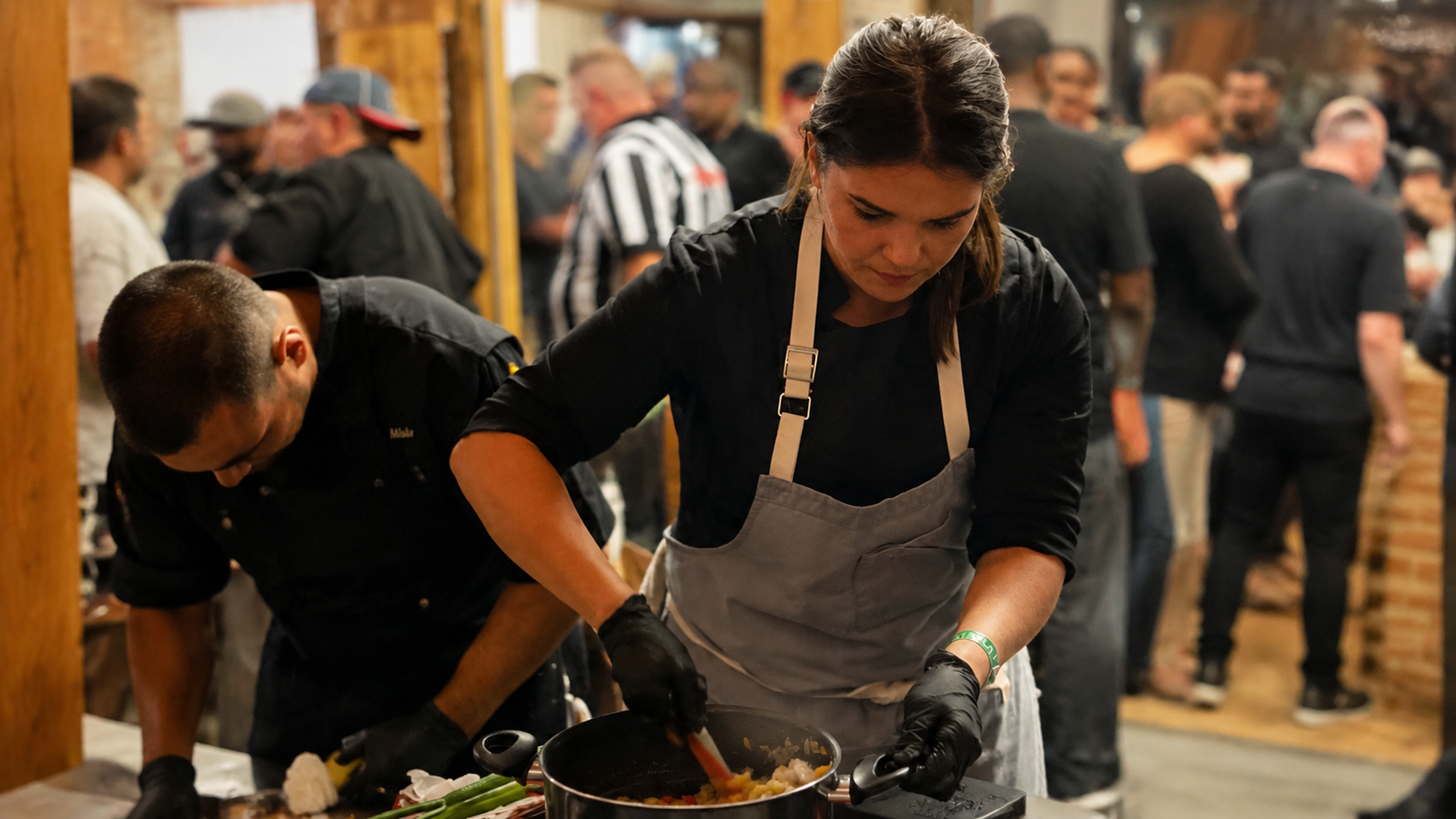
How hospitality rewarded everything I needed to unlearn—and what I want younger chefs to know.
In my twenties, I passed out at work with walking pneumonia.
I was a manager at Asiago’s Bakery and Deli, a small bakery and deli in Kalamazoo. I was washing dishes when my body finally gave up. The student clinic at Western Michigan University diagnosed me with walking pneumonia and told me I had run myself ragged.
That should have been a warning.
Instead, I turned it into a badge of honor.
I had worked with walking pneumonia. What a badass.
What a fucking idiot.
Hospitality did not create every unhealthy pattern I carried into adulthood. But it rewarded the hell out of them.
The industry praised my ability to keep moving when I was sick, exhausted, hungover, heartbroken or barely holding myself together. It rewarded my willingness to fill every gap, solve every problem and make myself available long after my body and brain had stopped cooperating.
It taught me that being dependable meant never having needs.
For a long time, I believed that was what made me strong.
As a young woman in professional kitchens—and a heavier, deeply insecure one—I felt as though I had to earn my place every minute I occupied it.
I learned to speak the language of the guys’ club. I laughed at the jokes, gave the shit back and made sure nobody could accuse me of being too sensitive. If confidence wasn’t naturally available, I performed it.
I became funny. Loud when necessary. Tough when expected. Helpful at all times.
I worked harder than everyone around me because I believed the second I stopped proving myself, someone might realize I didn’t belong there.
I also learned early how to read a room—to notice shifts in tone, anticipate tension and use humor or affection to soften it. It was a skill that served me remarkably well in hospitality.
Years later, though, I began to understand the difference between reading a room and feeling responsible for everything happening inside it.
That distinction matters when your job involves constant pressure, strong personalities and a hundred small emergencies before lunch.
When you are good at calming people, covering holes and fixing problems, people will happily let you do it.
Eventually, they may stop noticing what it costs you.
Worse, you may stop noticing too.
During the year-long casting process for Hell’s Kitchen, I made it through the final callbacks in Los Angeles. Then I learned I had not been selected for the current season, although I might still be considered for a future one.
I was devastated.
So naturally, I handled that disappointment with maturity, perspective and an evening of quiet reflection.
Just kidding. I drank and did Jägerbombs.
The following morning, while I was working as sous chef at Food For Thought’s Sidley Austin account, our breakfast cook called off. I arrived around five in the morning and made the biscuits, gravy and everything else we needed. I scrambled approximately thirty quarts of eggs and got breakfast set while periodically stepping away to throw up.
Then I went back to the line.
The team watched me get it done. I earned respect that morning, but I also silently established a dangerous expectation:
There are no excuses.
Not for me, anyway.
At the time, I believed that if my brain could overpower my hungover, exhausted or sick body, then my brain was stronger.
I understand it differently now.
I wasn’t proving that my mind was powerful. I was teaching myself to beat down every signal my body sent me.
Hungry? Ignore it.
Tired? Drink coffee.
Anxious? Keep moving.
Sad? Take another project.
Overwhelmed? Become more useful.
I once drank so much coffee during a shift that I threw up from the caffeine.
I still finished the shift.
Then I avoided coffee for a couple of days before carrying on as though vomiting from a legal stimulant was merely another quirky chef story.
Food wasn’t much better.
After leaving work around one in the morning, I would sometimes stop at the Jewel on Ashland in my chef whites and buy three Lean Cuisines—usually the Thai chicken spring rolls. I would microwave all three pouches, eat them with my final cocktail and somehow call that dinner.
During shifts, I often ate hunched over a garbage can like a rabid fucking animal.
That is the absurdity of professional cooking: you can spend an entire day making beautiful food for other people while treating your own nourishment like an inconvenience.
Today, I make intentional choices about how and when I eat. Intermittent fasting works well for me, but it is not right for every person or every body. If it works for you, use it intentionally so you are still properly nourishing yourself before or after your shift.
Better yet, work somewhere that gives you an actual lunch break, dinner break or family meal.
And maybe don’t build your diet around whatever fried carbohydrates are easiest to shove into your mouth over a trash can.
Up your protein. Drink water. Give your body something useful to work with.
Revolutionary chef advice, apparently.
The physical consequences of this work do not always arrive immediately. When you are young, your body can absorb an astonishing amount of neglect and still report for duty the next morning.
Then the years of repetitive movement begin introducing themselves.
Your shoulders remember every hotel pan you lifted incorrectly. Your wrists remember every sauté pan. Your feet remember every terrible shoe. Your back keeps an extremely detailed record of everything you assumed it would forgive.
Wear supportive footwear. Stretch and warm up before long shifts. Hydrate. Try compression socks. Use whatever safe support your body needs instead of waiting until pain becomes part of your personality.
I wear Nike terrycloth wristbands when I am working sauté or pulling things from the oven because I burn my wrists constantly. I am an ADHD clumsy asshole, and accepting that has been far more useful than pretending I will suddenly become graceful.
Self-care does not need to look glamorous.
Sometimes it looks like a wristband, a water bottle, a protein-heavy meal and refusing another cup of coffee because you already know how that story ends.
The harder lesson was learning that protecting yourself is not limited to your body.
For much of my career, I was a pathological people pleaser with a strong work ethic and an unfortunate enthusiasm for volunteering.
If something needed to be done and I believed I could do it better, I took it.
Menu writing? I’ll do it.
Account opening? I’m there.
Problem employee? Give them to me.
Emergency coverage? Of course.
I became incredibly useful, and people benefited from that usefulness.
But I also made myself very easy to use.
That does not mean every leader I worked for was bad. Some people saw me clearly, invested in me and genuinely cared about my growth. Others taught me through pressure, personality and the necessity of figuring things out for myself.
Over nearly three decades, I learned from all kinds of leaders—and sometimes from the absence of leadership altogether.
Some leaders made me stronger.
That doesn’t necessarily mean they led me well.
You can appreciate what someone taught you without believing you deserved the way they taught it.
A great leader does what they say they will do. They know the work they are asking of other people. They remember that their teammates have lives outside the building. They ask questions that are not exclusively about what they need from you.
They pay attention.
They care about mental health.
They walk their talk.
And they do not treat people like indentured servants because their name happens to be on the business.
I prefer the word teammate to employee. The business may be the owner’s dream, but the people working inside it are helping pursue a common goal. Their role deserves respect, and so does their humanity.
If your employer values your labor but cannot see the person performing it, you are working for the wrong person.
That does not mean you should walk out during service, have a meltdown or burn every bridge on the way to the parking lot.
Respect yourself, but respect the work too.
If you realize you are working for the wrong leader, protect your income and mental health while you quietly research better kitchens. Find the people whose work you admire. Figure out what they value and what you could learn from them.
Then leave professionally.
Give notice. Communicate honestly about why the position is not the right fit. Do not confuse self-respect with entitlement, and do not create a disaster for everyone else because you finally recognized that you deserve something better.
Your reputation follows you.
So does your nervous system.
Protect both.
Work did not only cost me physically. It strained relationships and, in some cases, cost me friendships.
I once had to help open a Food For Thought account in three days. The opening fell on the weekend of my former roommate’s wedding in Michigan, and I couldn’t go.
We did not speak for years.
We are friendly now, but I still carry guilt about missing it. I also understand that I made the best decision I could with the circumstances, priorities and emotional tools I had at the time.
Both things can be true.
Sometimes work took me away from the people I loved.
Sometimes I used work to avoid them.
When relationships became complicated—or when friends wanted more presence than I felt able to give—it was easier to keep working and then drink with my work people afterward. They understood the hours. They did not require me to explain why I was exhausted, unavailable or emotionally somewhere else.
Work gave me a place to hide while allowing me to call it ambition.
Choose friends who root for you even when you cannot always be there.
But understand that friendship still requires work. You cannot disappear indefinitely and expect everyone to remain exactly where you left them. Find people who respect your ambition, and be willing to show up for them when it matters.
Your career needs a support system.
It should not replace one.
Fire Thyme became the largest and most expensive demonstration of what happens when ambition outruns capacity.
I took over a space that had been a Pizano’s for seventeen years and transformed it into a cool, family-friendly restaurant in approximately seven months.
The building was around 10,000 square feet across two floors. The lower floor was entirely kitchen, office and storage. Upstairs held the restaurant, with nearly 150 seats and more than thirty teammates.
I was the interior designer, decorator, construction overseer, concept designer, chef and owner.
We completed the project for approximately $500,000. A comparable build-out could easily have approached $2 million.
That accomplishment remains extraordinary.
It also nearly destroyed me.
I came dangerously close to running out of money before the first payroll. The restaurant was incredibly popular during its first three months, but I had opened the doors already depleted.
My teammates did not receive the best version of me.
I treated them like people. I cared about them. But I could not give them the attention, detailed training or mentorship they deserved because I was constantly being pulled toward the building, vendors, finances and a thousand other moving parts.
Alcohol made that worse. It helped me numb the pressure while reducing my ability to be fully present for the people counting on me.
That is one of my greatest regrets.
I wanted to build the kind of kitchen where people could grow. Instead, I had built something so enormous that I barely had the capacity to stand inside it.
I had become everything the restaurant required and almost erased the person running it.
You can outwork the room without allowing the room to erase you.
That is the lesson I want younger chefs to learn much earlier than I did.
Be prepared to work.
Work harder than the people around you when the moment demands it. Develop discipline. Pay attention. Volunteer for opportunities that actually teach you something.
Trust your gut. Follow your instincts.
If you are not learning from the people around you, become your own teacher. Read, watch, eat and absorb everything you can in your free time. Study technique. Taste obsessively. Learn why something works instead of merely memorizing how one chef told you to do it.
A difficult chef may still teach you extraordinary technique.
Learn it without internalizing their opinion of your worth.
Someone who is not the strongest technical chef may still teach you humanity, patience and how people deserve to be treated.
Learn that too.
Your education will rarely arrive through one perfect mentor. Take the valuable pieces from each person without surrendering your identity to any of them.
Go to therapy if you can. Telehealth has made it more accessible, and there are affordable options if you look. Do not wait until your coping mechanisms become your personality.
Do not numb every feeling the minute it becomes inconvenient.
Rest before your body forces you to.
Eat like the person preparing your food matters.
Choose leaders who see you.
Choose friends who root for you.
And understand that having boundaries does not make you soft, lazy or less committed to your craft.
A thick skin is not the same as a healthy one.
A thick skin may help you tolerate pressure, criticism and difficult personalities. But it can also keep you from recognizing when something is hurting you.
It can make mistreatment feel normal.
It can make exhaustion feel noble.
It can make self-abandonment look like ambition.
Being a badass is not working with pneumonia, vomiting from caffeine, cooking through a hangover or ignoring every signal your body sends until it physically stops you.
Being a badass is protecting your body and brain so they can keep learning, earning and creating.
It is having the discipline to work hard—and the self-respect to know when the work is no longer worthy of you.
You do not have to disappear to prove that you belong in a kitchen.
Your talent matters.
Your ambition matters.
Your career matters.
But the person carrying all of it matters first.